
These two come up together for a reason. Both sit in the Terai belt of Uttar Pradesh, both are sal forest and grassland rather than the dry scrub most Indian tiger itineraries visit, and both are reachable from the Delhi side in a day's driving.
We are based at Dudhwa, so you can reasonably expect this article to lean one way. What we will not do is pretend Pilibhit has nothing going for it — it has several things, and on one measure it beats us outright.
At a glance
| Dudhwa Tiger Reserve | Pilibhit Tiger Reserve | |
|---|---|---|
| Area | About 1,284 sq km | About 730 sq km |
| Tiger reserve since | 1987 (national park 1977) | Notified under Project Tiger in June 2014 |
| Tourism zones | Three — Kishanpur, Dudhwa Zone 1, Katarniaghat | Centred on Chuka; safari departs from Mustafabad or Pilibhit City |
| From New Delhi | Further east along the Terai | 365 km (UP Ecotourism) |
| From Lucknow | About four hours by road | 252 km (UP Ecotourism) |
| Rhino | Yes — Rhino Area, Zone 1 | No |
| Barasingha | Yes — around half the world population | Not a feature of the reserve |
| Known for | Terai grassland, rhino, swamp deer, Kishanpur's tiger record | Sal forest, the Chuka reservoir, a fast-growing tiger population |
Area and notification details from the National Tiger Conservation Authority. Distances as published by UP Ecotourism. Season dates are set by the forest department each year and we reconfirm them when booking.
Distance: Pilibhit wins
Let us deal with this first, because it is the one thing Pilibhit genuinely does better if you are starting from Delhi or western UP.
UP Ecotourism lists Chuka as 365 km from New Delhi and 252 km from Lucknow. Dudhwa sits further east along the same Terai belt. If your single biggest concern is time in the car, Pilibhit is the shorter drive and there is no honest way around that.
What we would add is that the difference is a couple of hours on one road, once each way. On a two-night trip that is a real consideration. On a three-night trip it stops mattering much, and what you get to see starts mattering more.
Wildlife: what each one has
Where Pilibhit is strong
Pilibhit is a genuine conservation success story. It was recognised internationally in 2020 for doubling its tiger numbers in a far shorter span than the target, which is not a small thing for a reserve notified only in 2014. The National Tiger Conservation Authority describes it as holding some of the finest sal forest in the country, and five of India's seven deer species are found there, along with rare birds including the Bengal florican and the hispid hare.
The Chuka reservoir is its signature. Water, forest edge and birdlife in one place, and genuinely photogenic.
Where Dudhwa is strong
Dudhwa is close to twice the area, and more importantly it is three different places rather than one.
- Kishanpur has the strongest tiger-sighting record in the reserve, with Jhadi Tal, Beldanda and the Ring Road the names you will hear most.
- Dudhwa Zone 1 holds the Rhino Area — greater one-horned rhinos descended from animals brought from Assam and Nepal in the mid-1980s. No other reserve in this part of the country has them.
- Katarniaghat, about two hours further, is built around the Gerwa river, with Gangetic dolphins, gharials and crocodiles.
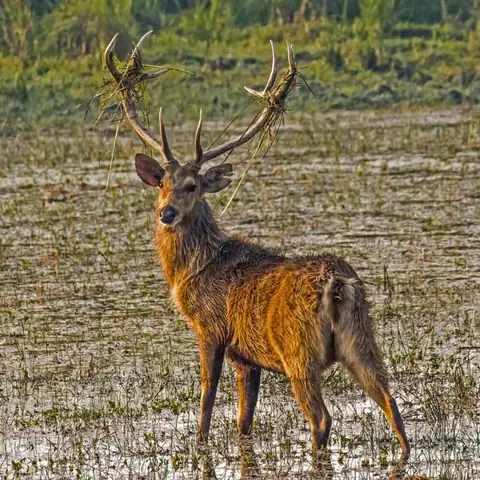
Then there is the barasingha. Dudhwa holds roughly half the world's population of swamp deer. Several hundred of them moving across open grassland at first light is the thing guests describe afterwards more often than the tiger, and it is not something Pilibhit offers.
Both reserves have tigers and neither can promise you one. Anybody who does is selling something.
Where you sleep
This is the practical difference most people only discover at the booking stage, so it is worth setting out plainly.
At Pilibhit, the accommodation UP Ecotourism lists at Chuka is its Tharu Huts and Tree Huts. The department's own tariff page tells visitors not to expect modern facilities such as air conditioning, television or WiFi, and notes that power for fans and lighting depends on supply and solar conditions. For some travellers that is exactly the appeal — a forest hut with no distractions. For a family with young children in December, or anyone who needs to answer a work email, it is something to know in advance.
On the Dudhwa side there are private resorts at the forest edge. Ours sits two to three minutes from the Kishanpur Zone gate, with air conditioning, geysers, power backup, a kitchen that cooks to order — Jain without onion or garlic, vegan, low-spice, allergen-free — and indoor and outdoor games for anyone travelling with children. Mobile signal is patchy, which is the forest's doing rather than ours.
Neither arrangement is better in the abstract. They suit different trips.
Season and timings
Both follow the Terai pattern: open through winter and spring, closed for the monsoon.
- Pilibhit — UP Ecotourism gives 15 November to 15 June as the ideal time to visit.
- Dudhwa — opened for the 2026-27 season on 1 November 2026, and usually closes in mid-June.
At Dudhwa there are two fixed weekly closures worth planning around: Kishanpur Zone is closed on Wednesdays and Dudhwa Zone 1 on Tuesdays. We build itineraries around them so no morning is lost. At both reserves, private vehicles are not permitted inside; safaris run in registered forest-approved jeeps.
Which one to pick
- Pick Pilibhit ifthe drive from Delhi is your main constraint, you have two nights at most, you like the idea of a simple forest hut, or Chuka's water-and-forest setting is what you came for.
- Pick Dudhwa ifwildlife is the actual point of the trip, you want rhino and tiger on the same visit, you want a choice of zones rather than one, or you are travelling with family who will want a proper room and a kitchen.
- Pick either ifyou simply want somewhere in the Terai that is not Corbett, with a permit still available for your dates. On that, both are far easier than the famous reserves.
Doing both
The two sit in the same belt, a comfortable drive apart, and visitors coming from the Delhi side often pass one on the way to the other. Four nights — two at each — covers both without rushing, and you get sal forest, a reservoir, grassland, rhino and three different zones out of one holiday.
If that is the shape of trip you want, tell us your dates and we will plan the Dudhwa half around whatever you book at Pilibhit. We would rather you had the better holiday than that you spent all of it with us.
