
Ask which is the best tiger reserve in North India and you will get an argument. Ask which is the easiest to actually visit and the question becomes answerable, because "easy" can be measured.
Most trips that fall apart do not fall apart over the wildlife. They fall apart over a permit that was not available, a drive that turned out to be longer than anyone said, or a hotel that was ninety minutes from the gate when the drive left at dawn.
So here is a way of judging a reserve on the things that actually decide whether your trip happens — and an honest account of where Dudhwa sits on each.
Test one: can you get a permit for your dates
This is the test that eliminates most trips, and the one people check last.
At Corbett, the reserve's own portal states that jeep safari reservations open up to 45 days in advance, with fresh slots released every Monday at 10:00 AM. That sounds generous until you realise what it means in practice: permits do not appear gradually, they appear in a weekly batch at a known hour, and a great many people — agents included — are waiting for it. The sought-after zones can be gone the same morning. The portal also notes that jeep safari is not available in Dhikala at all; that zone runs on canters.
Dudhwa works differently. For an ordinary weekday, a week or two of notice is usually enough, and we have arranged trips for guests who decided on a Tuesday and arrived that Friday.
Two caveats, because this would be a poor article without them. The Christmas to New Year week and long weekends do tighten up, and on those dates it is the rooms that run out before the permits — give yourself three to four weeks. And every forest permit anywhere in India, Dudhwa included, is issued against a name, a date and a shift, and does not move once raised.
Test two: how long is the journey
A reserve is only easy if getting there does not eat the holiday.
| From | Getting to Dudhwa |
|---|---|
| Lucknow | Roughly four hours by road. Nearest major airport, and the route most guests use. |
| Bareilly | Closer than Lucknow, with direct flights from Delhi, Mumbai and Bengaluru. |
| Delhi | A long but straightforward drive. Many break it with a night in Lucknow. |
| Shahjahanpur / Pilibhit side | Road through Puranpur and Mailani. Useful if you are already in the Terai belt. |
From Delhi the drive is comparable to the better-known reserve in the hills — a point we have written about separately in Corbett vs Dudhwa from Delhi. The difference is not the hours in the car. It is whether there is a permit at the end of them.
Test three: how far is your bed from the gate
This is the test nobody thinks about when booking and everybody thinks about at five in the morning.
A winter safari leaves before sunrise. If your hotel is an hour from the gate, your alarm goes at four, you dress in the cold, and you spend the first hour of your morning on a dark road instead of in the forest. Do that twice and the trip starts to feel like work.
Our resort is a two to three minute drive from the Kishanpur Zone gate. You leave your room shortly before the drive starts. On a December morning that is not a small convenience.
It matters at the other end too. Come back from a cold morning drive and breakfast is minutes away, not an hour.
Test four: how many days it needs
Some reserves need a week to do properly. Dudhwa does not, and that is part of why it works for people with ordinary jobs.
- One nightOne morning drive, then a long journey home. It can be done, but you will feel it was not quite enough.
- Two nightsThe realistic minimum. Two morning drives and an evening. Enough for Kishanpur Zone and a proper look at the grassland.
- Three nightsThe comfortable version. Kishanpur for tigers, the Rhino Area in Zone 1, a bird walk, and time to sit by a fire without watching the clock.
A two-night Dudhwa trip fits a normal weekend. That is a genuine advantage over reserves where the travelling alone consumes two days.
Test five: what is actually there
Easy is no use if there is nothing to see when you arrive. Dudhwa holds a combination that no other reserve in the region offers.
Tigers
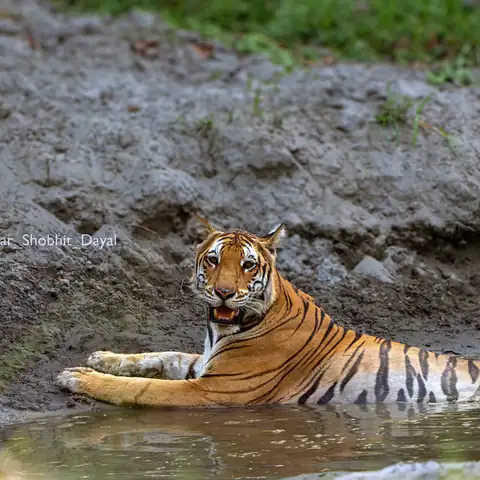
Kishanpur Wildlife Sanctuary has the strongest sighting record in the reserve. It sits a little above the surrounding country, which helps visibility, and the ground around Jhadi Tal, Beldanda and the Ring Road is where most sightings happen.
Rhinos
The Rhino Area inside Dudhwa Zone 1 holds greater one-horned rhinos, descended from animals brought from Assam and Nepal in the mid-1980s. No other reserve in this part of the country has them.
Swamp deer
Dudhwa holds roughly half the world's barasingha. Several hundred moving across open grass at first light is the image guests tend to describe afterwards, more often than the tiger.
Birds
Over four hundred and fifty species recorded, with winter migrants arriving from November. Bird walks need no safari permit, so a birder in the group is never waiting on a slot.
So which one
If you have had a permit in hand for six weeks and your heart is set on the hills, go. We would not try to talk you out of it, and we are not going to pretend the famous reserves are not worth their reputation.
But if you are a family with a long weekend, or a couple who decided on Thursday that next week should be spent somewhere with tigers in it, the reserve that answers is the one where the permit exists, the drive is manageable, the gate is three minutes from your bed, and the thing you came to see is still there.
On those five tests, Dudhwa is the easiest tiger reserve in North India to actually visit. Not the most famous. The easiest to get into — which, when your dates will not move, is the only measure that counts.
