
Most people plan a Dudhwa trip and then ask which zone to book. The honest answer, from a team that lives two minutes from the gate, is Kishanpur. Not because the tigers are different, but because Kishanpur is where you can actually see them. This guide covers what the sanctuary is, why its landscape works in your favour, what else lives there, and how to plan a trip around it.
- 2-3 minresort to Kishanpur gate
- 1 Nov 2026season opens
- ~450bird species in the reserve
What Kishanpur actually is
Dudhwa Tiger Reserve is not one forest. It is three protected areas run as one reserve: Dudhwa National Park, Kishanpur Wildlife Sanctuary and Katarniaghat Wildlife Sanctuary. Kishanpur sits in Lakhimpur Kheri district near Bhira, along the Sharda river, and it is the piece of the reserve closest to the road most visitors arrive on.
Unlike the dense sal forest you picture when someone says "tiger reserve", Kishanpur is a mosaic. Sal patches give way to tall grassland, grassland opens into wetland, and the whole thing is stitched together by a compact network of forest roads. That mix is why the sanctuary punches above its size, and why the forest department's own tourism material leads with it.
Why Kishanpur is the most reliable zone for tigers
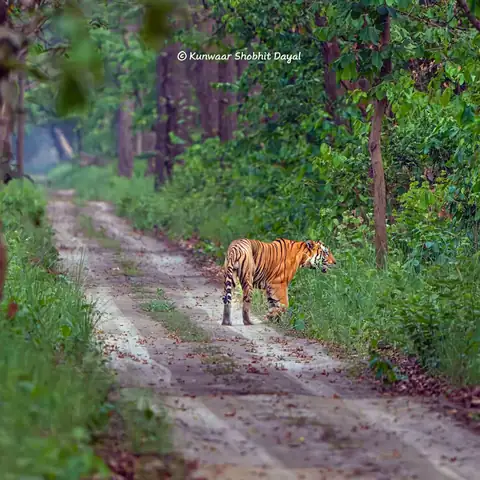
Dudhwa Tiger Reserve's tiger count has risen to 135, as reported by the UP forest department. Those tigers are spread across all three divisions. So the question is not where the tigers are, it is where your eyes can reach them. Three things make Kishanpur the better bet.
1. Open ground means longer sightlines
In closed forest, a tiger twenty metres off the road is invisible. In Kishanpur's grasslands you can scan two hundred metres of open ground from a stationary jeep. The same animal density produces far more sightings simply because the landscape does not hide them.
2. Water concentrates everything
Jhadi Tal and the smaller water bodies pull in prey, and prey pulls in predators. From March onward, as the other water dries, this effect sharpens: the tal becomes one of the few reliable drinking points in the zone.
3. A compact road network
Beldanda, the Ring Road and the tracks around Jhadi Tal cover the core in a single shift. You are not spending your safari driving between the good bits, which is the quiet way most safaris are wasted.
Jhadi Tal, the heart of the sanctuary
If you only remember one name from this post, make it Jhadi Tal. It is the large wetland at the centre of Kishanpur and the single most productive stretch of the zone.
- Swamp deer: herds of barasingha graze the grassland around the tal, often in the open. Dudhwa is one of the last strongholds of this deer in India.
- Winter birds: from November to February the water fills with migrants. Bring binoculars even if you came only for the tiger.
- Tigers: they come down to drink, and the open edges mean you see them when they do.
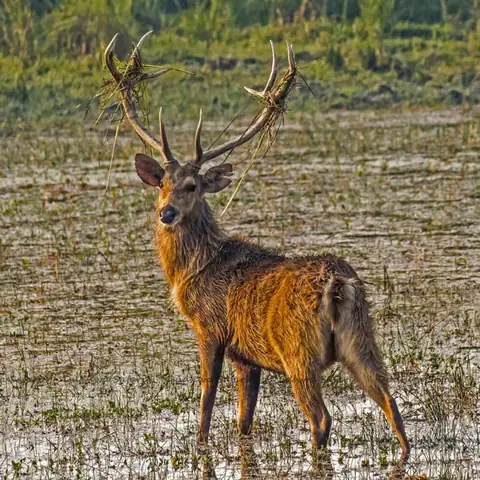
Ask your driver to spend time here rather than covering distance. A stationary jeep at the right edge of the tal, engine off, for twenty minutes, does more than an hour of driving.
What else you will see
A Kishanpur safari is rarely a blank even on a day the tiger does not show.
- Swamp deer, spotted deer, hog deer and sambar through the grassland
- Leopard, seen less often than the tiger here but present
- Wild boar, jackal and smooth-coated otters along the water
- Raptors on the dead trees along the forest roads; crested serpent eagles and fish eagles are regular
- Bee-eaters, kingfishers, storks and winter waterfowl around the wetlands
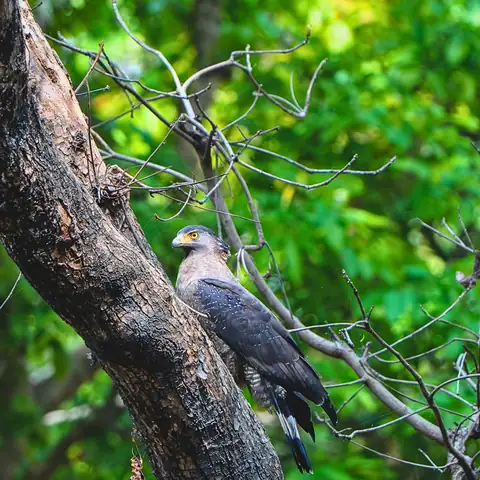
UP Ecotourism lists about 450 bird species for the reserve as a whole. If birds are the point of your trip, November to February is the window, and Kishanpur plus the resort garden will keep you busy without a single extra booking.
Best months and best shift
| Period | What it is like | Best for |
|---|---|---|
| November - December | Cold mornings, clear light, migrants arriving | Birders, families, photographers |
| January - February | Coldest. Heavy fog can delay the morning shift | Birds, grassland scenes, quiet forest |
| March - April | Warming up, water shrinking, animals moving to the tal | Tiger sightings, fewer crowds |
| May - mid June | Hot. Early morning and late evening only | The best tiger odds of the season |
Sightings are never guaranteed in any month. Our best time to visit Dudhwa page has the month-by-month detail.
Which shift? Morning, if you have to choose one. Animals move before the heat, the light is better for photographs, and the forest is quieter. The afternoon shift is still worth doing, especially from March onward when animals come to water late in the day.
Safari timings and booking
Current safari timings for the Kishanpur zone:
- Winter: 6:00-10:00 am and 2:30 pm to sunset
- Summer: 5:00-9:30 am and 3:00 pm to sunset
The 2026-27 season opens on 1 November 2026 and usually runs to about 15 June. Dates and timings are set by the UP forest department each year, so reconfirm before you travel.
You can book the permit yourself on the UP Ecotourism website, or send us your dates and group size and our team books the forest permit and jeep along with your stay. The full process, including what a permit covers and what it does not, is in our Dudhwa safari booking guide.
How to reach Kishanpur gate
| From | Approx. time | Route |
|---|---|---|
| Lucknow | ~4 hrs | Sitapur - Lakhimpur Kheri - Mehwagunj - Bhira |
| Delhi / Noida / Ghaziabad | ~7 hrs | NH9 - Moradabad - Rampur - Bareilly - Pilibhit Road - Mailani - Bhira |
| Shahjahanpur Jn | ~2.5-3 hrs | Via Khuttar - Mailani - Bhira |
| Bareilly | ~3.5-4 hrs | Pilibhit Road - Puranpur - Khuttar - Mailani - Bhira |
Drive times are approximate, to DTR Jungle Hideaways at the Kishanpur Zone gate. Full routes: Lucknow to Dudhwa and Delhi to Dudhwa.
After Mailani the roads become quieter district roads, so plan to finish the last stretch in daylight. Lakhimpur Kheri on the Lucknow route, and Bareilly on the Delhi route, are the last big towns for fuel, ATMs and pharmacies.
Where to stay for Kishanpur
The one decision that changes your trip more than anything else is how far your bed is from the gate. Staying in Palia or Lakhimpur means a 30-60 minute pre-dawn drive before every morning safari, and most guests quietly drop one safari because of it.
DTR Jungle Hideaways sits at the Kishanpur Zone gate, 2-3 minutes away. We handle the permit, the jeep and the timing, so your morning starts with tea rather than a drive. Rooms and the family cottage are on our rooms page, and ready plans are on our Kishanpur packages.
A 2-night plan that works
- Day 1, afternoon: arrive by lunch, afternoon safari in Kishanpur, evening around the bonfire.
- Day 2, morning: Kishanpur again, the best shift of the trip. Spend time at Jhadi Tal.
- Day 2, afternoon: a third Kishanpur safari, or the Rhino Area in Dudhwa Zone 1 (about 35-40 minutes away).
- Day 3, morning: one last Kishanpur safari, then check out.
That is three to four safaris in the zone with the best odds. A fuller version of this plan, with the drive from Delhi or Lucknow built in, is in our Dudhwa in 2 days itinerary.
Also read: Dudhwa safari season 2026-27 | Where to see tigers and rhinos | What to pack for a Dudhwa safari
